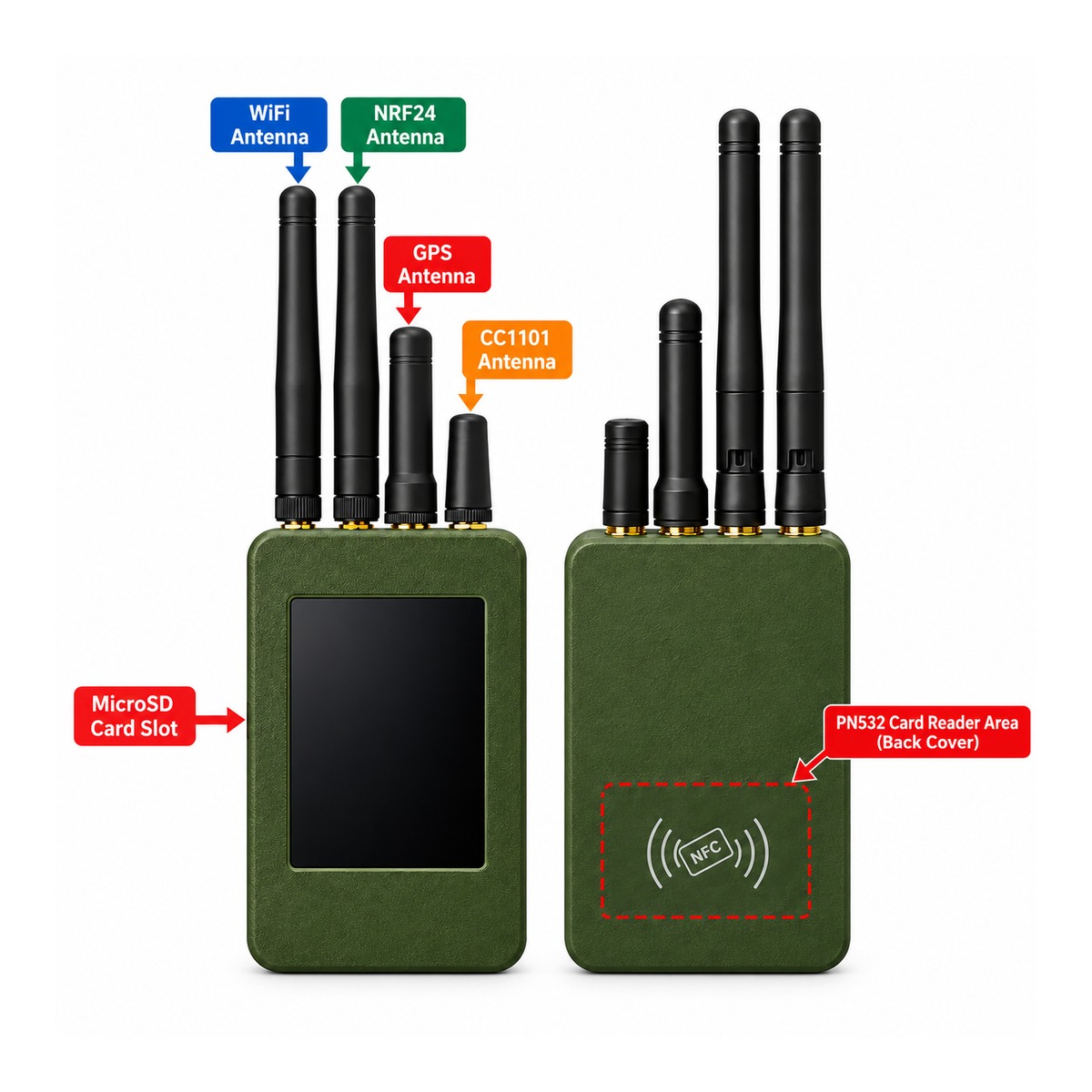
ESP32 multi-protocol wireless development board
The ESP32 multi-protocol wireless development board is an integrated multi-functional development platform suitable for development scenarios such as the Internet of Things, wireless communications, radio frequency development, NFC, GPS positioning, data recording, and custom embedded systems.
This version has completed the installation of the motherboard, wireless expansion board and 3D printed shell, and can be directly used for secondary development. The shell is available in Military Green and Orange.
The development board is designed based on the ESP32-WROOM-32E-N4 / ESP32-WROOM-32UE-N4 module. It integrates a 2.8-inch touch display, Sub-GHz RF, 2.4GHz RF, NFC, GPS, Wi-Fi, Bluetooth, MicroSD/TF card and battery-related functions in one device, providing an integrated development platform for a variety of wireless and IoT projects.
Main functions
• ESP32-WROOM-32E-N4 / ESP32-WROOM-32UE-N4 main control module
• Wi-Fi wireless connection
• Bluetooth connection
• 2.8-inch ST7789 TFT display
• 240 × 320 resolution
• XPT2046 resistive touch
• CC1101 compatible with Sub-GHz RF modules
• NRF24 compatible with 2.4GHz RF modules
• PN532 NFC SPI interface
• GPS UART interface
• MicroSD / TF card interface
• Battery interface
• Battery voltage detection
• Onboard TP4056 charging circuit
• USB Type-C download and serial interface
• CH340C USB to serial port chip
• BOOT button
• RESET button
• Multiple devices share SPI bus design
• 3D printed housing installed
• Military green/orange casing available
2.8-inch touch display
The development board features a 2.8-inch ST7789 TFT color display with a resolution of 240 × 320.
The touch function uses the XPT2046 resistive touch controller.
The display backlight supports PWM brightness adjustment, which can be used to develop custom graphical interfaces, device menus, sensor data displays, status dashboards, control panels and other applications.
The touch controller uses independent SPI pins and is independent of the RF/TF card sharing the SPI bus.
Multi-protocol wireless development platform
One of the biggest features of this development board is that it integrates a variety of wireless communication and peripheral interfaces into an ESP32 platform.
Supported wireless and communication features include:
• Wi-Fi
• Bluetooth
• CC1101 is Sub-GHz RF compatible
• NRF24 compatible with 2.4GHz RF
• PN532 NFC
• GPS positioning interface
Developers can develop and test multiple wireless communication technologies on the same device without building multiple independent development boards.
CC1101/Sub-GHz RF
The wireless expansion board provides CC1101-compatible Sub-GHz RF development capabilities.
Provides independent:
• CSN
• GDO0
• GDO2
• TX_EN
• RX_EN
Wait for the control signal.
Can be used for Sub-GHz wireless communications, RF experiments, and custom wireless project development.
NRF24 / 2.4GHz RF
The development board also provides NRF24-compatible 2.4GHz wireless radio frequency development functions.
The NRF24 RF section uses a shared SPI bus and provides independent CSN and CE control signals.
Suitable for various 2.4GHz wireless communications and related embedded development projects.
PN532 NFC interface
The wireless expansion board provides the PN532 NFC SPI interface.
PN532 interface definition:
SCK:GPIO18
MISO:GPIO19
MOSI:GPIO23
CS:GPIO17
This interface does not lead to IRQ and RST signals, and SPI polling should be used when developing software.
Can be used for NFC tag reading, card recognition, and other PN532-compatible NFC applications.
GPS interface
The development board provides an independent GPS interface that can be used to connect external GPS positioning modules.
The expansion board GPS interface provides:
• 3.3V power supply
• GND
• UART data input
The TX data of the GPS module is connected to ESP32 GPIO1.
Can be used for GPS positioning, location data collection, mobile devices, IoT positioning and related project development.
MicroSD/TF card
The development board has an onboard MicroSD/TF card interface for local data storage.
TF card adopts SPI mode:
SCK:GPIO18
MISO:GPIO19
MOSI:GPIO23
CS:GPIO5
Available for:
• Data logging
• Configuration file storage
• Image and UI resource storage
• Sensor data storage
• Other local file storage applications
battery support
The development board provides battery-related hardware and can be used for portable ESP32 project development.
Onboard battery voltage detection function, sampling the battery voltage through ESP32 GPIO34.
In actual use, it is recommended to perform software calibration based on the ADC benchmark and actual prototype measurement results.
The development board also integrates the TP4056 charging management circuit.
Based on the current hardware design, the charging current is approximately 360mA.
USB Type-C Download and Debugging
The development board provides a USB Type-C interface.
The USB interface connects to the ESP32 through the CH340C USB to serial chip, which can be used for:
• Firmware download
• Serial communication
• Serial debugging
• Automatic download control
The development board also provides independent BOOT and RESET buttons to facilitate firmware development and debugging.
Shared SPI bus architecture
MicroSD/TF cards, PN532, and some radio frequency devices in wireless expansion boards share the following SPI bus:
SCK:GPIO18
MISO:GPIO19
MOSI:GPIO23
Different devices use their own independent CS/chip select signals.
When developing your program, you should ensure that only the device that currently requires communication is selected, and the CS of other SPI devices should remain high.
development environment
The hardware GPIO definition of this development board can be used as the basis for the following development environments:
• Arduino
• PlatformIO
• ESP-IDF
Developers can develop display interfaces, touch operations, wireless communications, NFC, GPS, data logging and other functions based on project needs.
Important development considerations
• All ESP32 GPIO signals are 3.3V level.
• Do not directly input 5V level to ESP32 GPIO.
• GPIO34, GPIO35, GPIO36, GPIO39 can only be used as inputs.
• GPIO0 is also the BOOT startup configuration pin of ESP32. Do not continue to pull GPIO0 low during power-on and reset.
• MicroSD, PN532 and some RF modules share the SPI bus. When developing software, you need to correctly manage the CS chip select signals of each device.
• GPS UART and CH340C USB serial port use some shared signals.
• When developing related to GPS and firmware download, you need to pay attention to the issue of serial port resource sharing.
Applicable development scenarios
This product is suitable for:
• ESP32 development
• IoT Internet of Things Development
• Wireless communication development
• Sub-GHz RF development
• 2.4GHz RF development
• NFC project
• GPS positioning project
• Embedded graphical interface
• Sensor projects
• Smart home
• Home Automation
• Data logging
• Wireless device testing
• Portable ESP32 projects
• Multi-protocol communication experiment
• Prototype product development
• Teaching and Research
product specifications
Product type:
ESP32 multi-protocol wireless development board
Main control:
ESP32-WROOM-32E-N4 / ESP32-WROOM-32UE-N4
Display:
2.8-inch ST7789 TFT
Resolution:
240 × 320
touch:
XPT2046 resistive touch
Wireless connection:
Wi-Fi
Bluetooth
RF function:
CC1101 is Sub-GHz RF compatible
NRF24 2.4GHz RF compatible
Other interfaces:
PN532 NFC
GPS UART
MicroSD/TF card
Battery interface
USB:
USB Type-C + CH340C USB to serial port
shell:
3D printed housing
Shell color:
Army green
orange color
Product status:
The motherboard, wireless expansion board and 3D printed casing have been installed.
This product is mainly used for development, prototyping, research, teaching and custom projects.
This product is a development platform, not a finished consumer device with a fixed single function. Different projects may require users to develop, compile or configure corresponding software and firmware by themselves.